

By Francean McCall, Founder and Teacher at functionaleducation.com
One of the greatest advantages of homeschooling is the freedom to teach children in a way that works for them. For neurodiverse children, particularly those with ADHD, autism, dyslexia or other learning differences, this flexibility can make a tremendous difference.
Over my years of teaching, I've come to appreciate just how differently children process information, manage their attention and approach new challenges. Some children need to move to concentrate. Others need more time to process instructions. Some grasp complicated ideas quickly but struggle with tasks that appear relatively simple.
The important thing is recognising that children don't all need to learn in the same way, or at the same pace.
Here are five approaches I encourage homeschooling families to consider, many of which have shaped the way I teach.
Many neurodiverse children benefit from knowing what comes next. Predictability can reduce anxiety, make transitions easier and free up mental energy for learning.
However, there's an important difference between having a rhythm and following a rigid timetable.
Instead of planning every minute of your homeschooling day, create a familiar sequence of activities. You might begin with movement, move into literacy or numeracy, take a break outdoors, then return to another learning activity.
Try using a simple visual schedule so your child can see what's coming. For children who struggle with transitions, a gentle reminder before changing activities can also help.
A familiar rhythm in learning can make a real difference. I like to introduce new ideas in small, manageable steps, building on what children already know. Repetition and consistency help children feel more confident about what they're doing, while still allowing them to progress at their own pace.
My tip: Keep the order of your day reasonably consistent, but be prepared to change the timing. A child who needs an extra 15 minutes outside may return much more ready to learn.
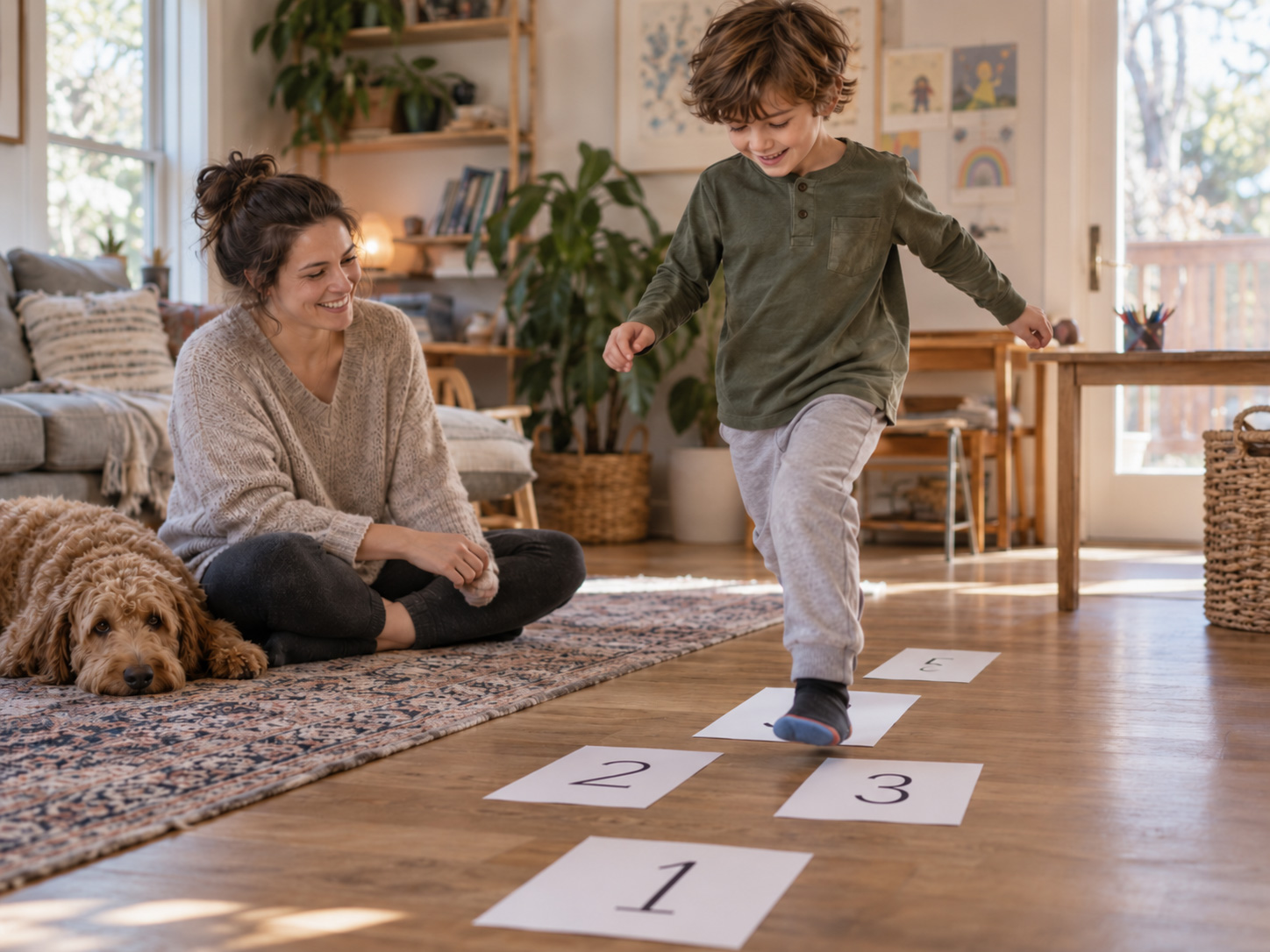
We often associate concentration with sitting quietly at a desk. But for some children, particularly those with ADHD, movement can actually support attention and engagement.
A 2023 review by Song and colleagues, examining 24 studies involving 914 children and adolescents with ADHD, found that physical activity interventions improved aspects of executive functioning, including working memory, inhibitory control and cognitive flexibility.
Learning doesn't always have to happen while sitting down.
Try practising times tables while jumping on a trampoline, spelling words with large arm movements or counting steps as you walk around the garden.
This is something I incorporate regularly into my teaching. In early numeracy, we use songs, clapping, rhythmic counting and movement activities to explore number patterns. When learning multiplication, for example, children can practise skip counting through movement before progressing to written equations.
In literacy, I introduce letter sounds through actions, stories and physical activities before asking children to write them.
My tip: If your child is struggling to concentrate, try changing how they're learning before assuming they're unwilling to learn.

Abstract thinking develops over time, and many children benefit from experiencing a concept physically before being expected to understand it on paper.
Research supports this approach. A 2013 meta-analysis by Carbonneau, Marley and Selig examined 55 studies involving more than 7,000 students. It found that teaching mathematics with physical manipulatives produced better learning outcomes, on average, than instruction using abstract symbols alone.
Consider teaching addition using blocks, beads or household objects rather than beginning with written equations.
When teaching place value, physically grouping objects into tens and hundreds allows children to see how numbers work.
This approach is fundamental to the way I teach mathematics. Children begin with practical materials such as number rods, counting tools and Montessori-inspired manipulatives. As their understanding develops, we gradually move towards written and mental strategies.
Literacy can be approached similarly. Children might form letters using modelling clay, build words with letter cards or practise handwriting through drawing and craft activities.
These activities aren't simply extras to make lessons more enjoyable. They help children build an understanding of what they're learning.
My tip: Whenever a concept feels difficult, ask yourself whether you can make it visible, physical or practical.

One of the difficulties children can experience in traditional classrooms is being expected to progress through learning at the same rate as their peers.
Yet children's abilities rarely develop evenly.
A ten-year-old might have an excellent vocabulary and a wonderful imagination but still find spelling or handwriting challenging. Another child might be confident with multiplication while needing more support with basic number relationships.
This is sometimes described as an uneven learning profile, and it's particularly common among neurodiverse learners.
When homeschooling, you have the opportunity to respond to those differences.
Rather than working backwards from what a child should know at a particular age, begin by identifying what they already understand. Then introduce the next manageable step.
In my literacy and numeracy teaching, I organise learning into progressive stages. Children can begin at the point that matches their current understanding and move forward as they're ready.
I also encourage families not to rush foundational skills. Taking additional time to develop a secure understanding now can make more advanced learning much easier later.
My tip: Measure progress against where your child was last month, rather than where another child is today.
Perhaps the most important consideration of all is how your child feels about learning.
Some neurodiverse children arrive at homeschooling after experiencing considerable frustration or anxiety at school. They may have begun to associate academic work with failure, even when they're capable and curious learners.
Rebuilding confidence takes patience.
Begin with achievable tasks and provide opportunities for success. Notice effort, persistence and growing independence, rather than focusing exclusively on correct answers.
Give children opportunities to explore subjects they find interesting, and remember that breaks, creative activities and time outdoors are valuable parts of their day.
I love using storytelling, art, music and practical experiences in teaching because they create different pathways into learning. A child who struggles with a written explanation may understand the same concept beautifully when it's presented through a story or hands-on activity.
And when something isn't working, it is perfectly reasonable to stop, approach it differently and try again another day.
My tip: End a learning session while your child still feels capable, rather than pushing through until they're frustrated or exhausted.
There is no single teaching method that suits every neurodiverse child. What works wonderfully for one child may be completely unsuitable for another, even when they share the same diagnosis.
That's why observation is such an important part of homeschooling.
Pay attention to when your child is most engaged, what environments help them concentrate and which activities leave them feeling successful.
You don't need to change everything at once. Start with one or two small adjustments and see what difference they make.
Above all, remember that education is not a race. The aim is to help children develop knowledge, skills, independence and a lasting relationship with learning.
And sometimes, the greatest progress happens when we give children the time, space and freedom to learn in their own way.
Francean (Fran) McCall is the founder and teacher behind functionaleducation.com, a New Zealand-based home education programme offering structured, video-based lessons for homeschooling families.
Song, Y., Fan, B., Wang, C., & Yu, H. (2023). Meta-analysis of the effects of physical activity on executive function in children and adolescents with attention deficit hyperactivity disorder. PLOS ONE, 18(8), e0289732.
https://doi.org/10.1371/journal.pone.0289732
Carbonneau, K. J., Marley, S. C., & Selig, J. P. (2013). A meta-analysis of the efficacy of teaching mathematics with concrete manipulatives. Journal of Educational Psychology, 105(2), 380–400.
https://eric.ed.gov/?id=EJ1007941
Zhu, X., et al. (2023). Comparative effectiveness of various physical exercise interventions on executive functions and related symptoms in children and adolescents with attention deficit hyperactivity disorder: A systematic review and network meta-analysis. Frontiers in Public Health, 11, 1133727.
Up to 2 hours of lessons a day, plus hands on activities means you can easily give your child a quality education at home.
View Course OverviewInstant access. No credit card required.
We respect your privacy and won't give your email to anyone else.
Please watch our getting started video which covers a lot of the questions you may have.
The Parent Dashboard is where parents manage their Functional Education account. You can manage your plan and billing, update payment details, add or remove students, change a student’s class, view invoices, and check learning access and progress.
Students use a separate Learning Hub login to access their lessons.
New to Functional Education? Create your parent account here.
Already have an existing Functional Education account? Connect it here.
Parents can sign in to the Family Dashboard here to manage their plan, billing, students and progress.
New to Functional Education? Create your parent account here.
Already have an existing Functional Education account? Connect it here.
Start your 7-day free trial here. Create your parent account, choose a course and plan size, then add your student or students. No credit card is required to start the trial. Here is a video explaining how to get started.
Classes are numbered by the equivalent year of schooling: Class 1 is the first year, Class 2 is the second year, and so on. Choose the level that best matches your child’s current learning needs rather than relying only on their age.
If the class is too easy or too hard, you can easily change it from the Family Dashboard.
A Family Pass supports up to five students from the same family. Parents manage all students, billing and progress from one Family Dashboard account.
Each student has separate Learning Hub access and progress. Students do not share the parent’s dashboard login.
Don’t have a Family Dashboard yet? Create your parent account here.
If you have a Family Pass, sign in to the Family Dashboard and select Add student in the Your students section. Enter the student’s details and follow the prompts. Each student needs their own email address so their learning access and progress stay separate.
If you are not currently on a Family Pass, use Change plan on your dashboard to choose a plan that supports additional students.
Don’t have a Family Dashboard yet? Create your parent account here.
Sign in to the Family Dashboard. Your trial summary will show when the trial ends and which plan you selected. Choose Start plan, review the billing details, and add your payment method through Stripe Checkout.
If you are currently on a free trial, sign in to the Family Dashboard when you are ready to continue. Your trial summary will show the plan you selected; choose Start plan to continue with that plan, or Change plan to review other options before adding your payment method.
If you do not continue, your 7-day trial ends automatically and you will not be charged.
Your 7-day free trial ends automatically unless you choose Start plan in the Family Dashboard and add a payment method. If you do not continue, you will not be charged.
Check your spam or junk folder first, then make sure you entered the correct email address. You can request a new verification code from the Family Dashboard sign-in screen.
If the code still does not arrive, contact support@functionaleducation.com and tell us the email address you used to register.
Sign in to the Family Dashboard. On your Current plan card, select Change plan, choose Weekly, review the billing summary, and confirm the change.
You do not need to cancel or wait for your current billing period to end.
Don’t have a Family Dashboard yet? Connect your existing account here first.
Holidays are easier with the Family Dashboard. Sign in to the Family Dashboard and select Pause or cancel on your Current plan card.
Choose whether to pause for a number of weeks or until a specific restart date. No charges are made while your plan is paused, and billing will restart on the date you choose. Your students can continue learning until the access end date shown in the dashboard.
Don’t have a Family Dashboard yet? Connect your existing account here first.
If you need help with your account, billing or student access, email support@functionaleducation.com.
For account and billing questions, please include the parent email address associated with your Family Dashboard. For student-learning issues, include the student’s name and learning login email.
You can start your child anytime.
This question is on the MoE application form in New Zealand.
Functional Education delivers lessons that align with the standard NZ curriculum. They are designed to sequentially follow the natural learning progress for each year level. There are planning sheets provided for each topic covered and these sheets contain learning goals and outcomes so that parents can clearly see what the child is aiming to achieve. The senior classes from Class 4-7 have weekly spelling tests. Each topic is designed to have a project/presentation at its conclusion. Some children will present to their families, others will access our platform and share their projects with 'classmates' and receive/give peer feedback as part of this process.
School workbooks are kept as a record of the child's learning throughout the year, along with handcrafts, art and photographs.
Below is a playlist of videos that cover the learning steps for each class, in reading, writing and maths. You may find this useful when applying for an exemption. There is also a short description of what we cover in each course on the curriculum overview page.
Use the playlist button (top right of this youtube player) to skip between classes and subjects)
Home schooling applications are different in each country and region. Before you apply to have a homeschool exemption we suggest you follow these steps:
If you are in New Zealand, and need further help with your exemption, Cynthia Hancox has various resources on her website that can help, as well as an application writing service. Cynthia and her team have processed many exemptions for families planning to use Functional Education.
To view all the relevant laws and requirements for homeschooling in New Zealand. You can read the entire Education and Training Act 2020 here
Our friend Cynthia Hancox has written a fantastic summary of the act here: http://www.cynthiahancox.com/information/relevant-laws-education-and-training-act-2020
Fran’s teaching style is warm, calm, and consistent. Many parents tell us that children who flatly refused to participate in school activities are willing to try Functional Education — often because the classroom pressure is gone, the sensory environment is controlled, and the same familiar teacher shows up every day. The 7-day trial is the best way to find out. There is nothing to lose.
This is the question almost every parent asks. The short answer is: not with a structured programme in place. Functional Education covers all core learning areas at the appropriate level for your child’s year. Many families find that their child actually progresses faster at home, in an environment where the pace is theirs and the anxiety is lower.
info@functionaleducation.com
Questions? Chat directly with the principal on Facebook Messenger.